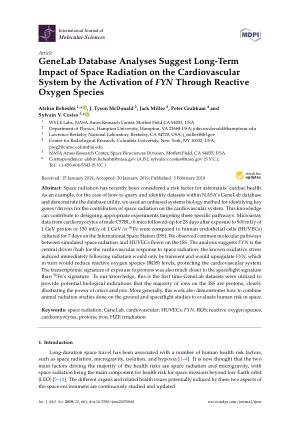
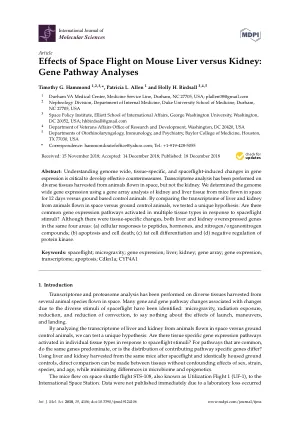
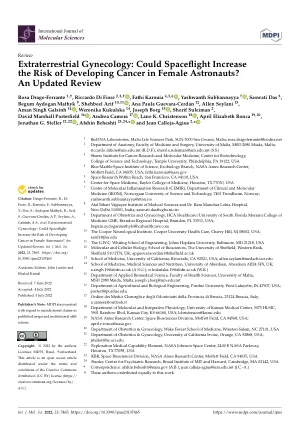
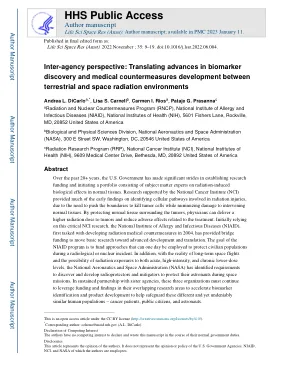
NASA GeneLab platform utilized for biological response to space radiation in animal models
- McDonald JT, Stainforth R, Miller J, Cahill T, da Silveira WA, Rathi KS, Hardiman G, Taylor D, Costes SV, Chauhan V, Meller R, Beheshti A
- February 7, 2020
This research paper examines how space travel can affect our health due to radiation exposure in outer space. Our bodies are exposed to different types of particles that come from the sun and even outside our solar system when we go into space, which could potentially damage our DNA-the blueprint for all living things within us. This study specifically looked at cells taken from rats' mammary glands (breast tissue), human endothelial cells (which line blood vessels), and fibroblast cells (involved in wound healing) to understand how these particles might harm our bodies during space travel or similar radiation experiments on Earth. The researchers found that exposure to this type of high-energy, heavy atomic nuclei-known as GCR HZE particles-can cause significant damage within cells and lead to unrepaired DNA breaks which could increase the risk for diseases like cancer in humans who travel into space or participate in ground-based radiation experiments.
This research paper presents a comprehensive analysis of the effects of spaceflight or analogous ground-based radiation experiments on various biological systems using cultured cells and tissues from rats, humans (endothelial cells and fibroblasts), as well as mammary gland samples. The study's primary objective was to understand how ionizing radiation in the space environment impacts DNA integrity within these different cell types-a critical factor for assessing cancer risk during human space travel. The methodology employed a combination of laboratory experiments and computational modeling, with cultured cells exposed to simulated galactic cosmic ray (GCR) environments or actual radiation doses mimicking those encountered in low Earth orbit (LEO). The researchers utilized three cell types: rat mammary gland tissue, human endothelial cells, and fibroblasts. These were cultured under controlled conditions to assess the extent of DNA damage post-radiation exposure using various molecular biology techniques such as comet assays for detecting single and double-strand breaks in DNA fragments within individual cells (single cell gel electrophoresis).
MLA
JT, McDonald, et al. “NASA GeneLab platform utilized for biological response to space radiation in animal models.” PubMed Central, National Center for Biotechnology Information, https://www.ncbi.nlm.nih.gov/pmc/articles/PMC7072278/. Accessed 30 Sept 2026.
Chicago
JT, McDonald, et al. “NASA GeneLab platform utilized for biological response to space radiation in animal models.” PubMed Central. 30 September 2026. https://www.ncbi.nlm.nih.gov/pmc/articles/PMC7072278/.