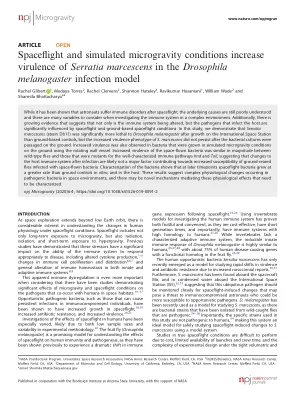
Asparagine biosynthesis as a mechanism of increased host lethality induced by Serratia marcescens in simulated microgravity environments
- Gilbert R, Tanenbaum N, Bhattacharya S
- May 4, 2022
This research looks into how certain bacteria might become more harmful to humans when exposed to conditions similar to those in space. Specifically, the study focuses on a common opportunistic germ called Serratia marcescens and uses special lab equipment that mimics low gravity (microgravity) here on Earth. The scientists found out this bacterium becomes more dangerous under these simulated microgravity conditions when tested with fruit flies as hosts, which could mean astronauts might face greater health risks during space missions due to infections from such germs. This study is important because it helps us understand potential threats and prepare better ways to protect the crew's health on future trips into space where medical help isn't always close by.
The research paper investigates the increased virulence of Serratia marcescens, an opportunistic gram-negative bacterium known for causing infections that are typically harmless until triggered by specific environmental conditions. The study's primary objective was to understand how microgravity influences pathogenicity using a ground-based simulation method called Low-Shear Modeled Microgravity (LSMMG). The researchers employed Drosophila melanogaster, commonly known as fruit flies, which are frequently used in biomedical studies due to their genetic similarities with humans. The study utilized two strains of fly lines: the wild-type and a mutant that is more susceptible to S. marcescens infection. The methodology involved infecting both Drosophila melanogaster host groups (wild type, resistant) with either space flight or LSMMG treated Serratia marcescens and monitoring the mortality rates of each group over time to assess virulence changes in a simulated microgravity environment.
MLA
R, Gilbert, et al. “Asparagine biosynthesis as a mechanism of increased host lethality induced by Serratia marcescens in simulated microgravity environments.” PubMed Central, National Center for Biotechnology Information, https://www.ncbi.nlm.nih.gov/pmc/articles/PMC9111996/. Accessed 30 Sept 2026.
Chicago
R, Gilbert, et al. “Asparagine biosynthesis as a mechanism of increased host lethality induced by Serratia marcescens in simulated microgravity environments.” PubMed Central. 30 September 2026. https://www.ncbi.nlm.nih.gov/pmc/articles/PMC9111996/.