Persistent NF-κB activation in muscle stem cells induces proliferation-independent telomere shortening
In a recent study published by Cell Reports, researchers have been investigating how persistent activation of NF-κB-a protein complex that plays a key role in regulating the immune system and inflammation-affects muscle stem cells called MuSCs. These findings are important because they could help us understand why some people's injuries heal poorly, while others recover quickly. The researchers used mice with specific genetic changes to either overactivate or underactivate NF-κB in their muscle stem cells and observed the effects on these cells without any injury first. They found that even when there was no apparent harm done to the uninjured MuSCs, persistent activation of this protein complex led them down a path where they started dividing more often than usual-even though it's not necessary for their normal functioning or healing process after an injury.
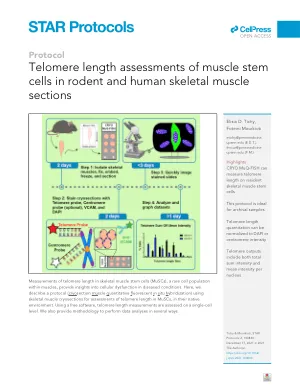
In this study, published by SUPPLEMENTAL DATA authors Elisia D. Tichy et al., the role of NF-κB signaling in muscle stem cell (MuSC) function and telomere dynamics was investigated using genetically modified mouse models: IKK2CAMuSC, which lacks functional IKK2 kinase activity specifically within MuSCs, and NEMOKOMuSC that has a loss of NF-κB activation due to the absence of p50/p65 binding protein 3 (NEMO). The primary objective was to understand how persistent inactivation of this pathway affects muscle stem cell proliferation as well as telomere length, which is crucial for maintaining genomic stability. Methodologically, the study employed several techniques including quantitative Real-Time PCR (qRT-PCR) to measure gene expression levels and Hematoxylin and Eosin staining coupled with MuQ-FISH assays to assess telomere length in uninjured muscle tissues.
MLA
ED, Tichy, et al. “Persistent NF-Œ∫B activation in muscle stem cells induces proliferation-independent telomere shortening.” PubMed Central, National Center for Biotechnology Information, https://www.ncbi.nlm.nih.gov/pmc/articles/PMC8183356/. Accessed 30 Sept 2026.
Chicago
ED, Tichy, et al. “Persistent NF-Œ∫B activation in muscle stem cells induces proliferation-independent telomere shortening.” PubMed Central. 30 September 2026. https://www.ncbi.nlm.nih.gov/pmc/articles/PMC8183356/.