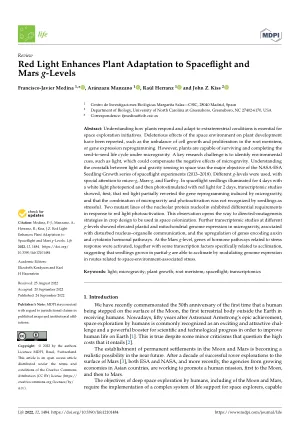
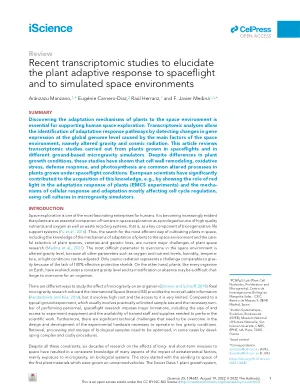
The importance of Earth reference controls in spaceflight-omics research: Characterization of nucleolin mutants from the Seedling Growth experiments
- Manzano A, Villacampa A, Sáez-Vásquez J, Kiss JZ, Medina FJ, Herranz R
- October 15, 2020
This research study focuses on how plants respond when they are exposed to different types of light and gravity changes-like what might happen if humans lived in space for a long time. The scientists looked at three special plant varieties that have genetic differences, which helped them understand better why some plants react the way they do under these conditions. The main finding is that all kinds of plants seem to handle light and gravity changes similarly when it comes down-regulating certain parts-these are like their internal switches for growth or defense mechanisms. However, there's a twist: while most genetic varieties responded in the same way overall, one particular type (called nuc1-2) showed unique reactions to red light and didn't react at all when it came to another common response involving green light-which is pretty interesting! Digging deeper into what these plants do with their energy under different lights led researchers to discover that the plant called 'nuc1-2,' which doesn't respond well in one way, actually uses more of its internal power source (Calvin cycle) when exposed to red light.
This research paper investigates how Arabidopsis thaliana seedlings respond to microgravity and red light conditions using a nuc1-2 mutant as an experimental model. The study's methodology involved exposing both wild type (WT) and the nuc1-2 genotype of A. thaliana seeds, which are downregulated in response to gravity due to their altered gravitropic sensitivity, to red light conditions onboard a spaceflight experiment aboard NASA's Space Shuttle Endeavour as part of Plant Habitat Enhancement (PHE) 1. Key findings from the study revealed that both WT and nuc1-2 seedlings exhibited similar downregulated responses to gravity, suggesting a global effect primarily driven by an increased number of up-regulated differentially expressed genes (DEGs). Notably, there were distinct differences in gene expression between these two groups when exposed to red light.
MLA
A, Manzano, et al. “The importance of Earth reference controls in spaceflight-omics research: Characterization of nucleolin mutants from the Seedling Growth experiments.” PubMed Central, National Center for Biotechnology Information, https://www.ncbi.nlm.nih.gov/pmc/articles/PMC7607443/. Accessed 30 Sept 2026.
Chicago
A, Manzano, et al. “The importance of Earth reference controls in spaceflight-omics research: Characterization of nucleolin mutants from the Seedling Growth experiments.” PubMed Central. 30 September 2026. https://www.ncbi.nlm.nih.gov/pmc/articles/PMC7607443/.