Impact of Spaceflight and Artificial Gravity on the Mouse Retina: Biochemical and Proteomic Analysis.
- Mao XW, Byrum S, Nishiyama NC, Pecaut MJ, Sridharan V, Boerma M, Tackett AJ, Shiba D, Shirakawa M, Takahashi S, Delp MD
- August 28, 2018
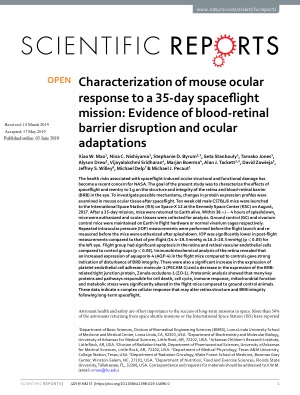
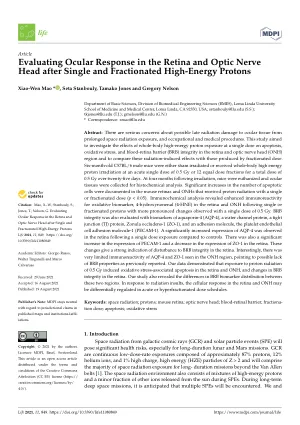
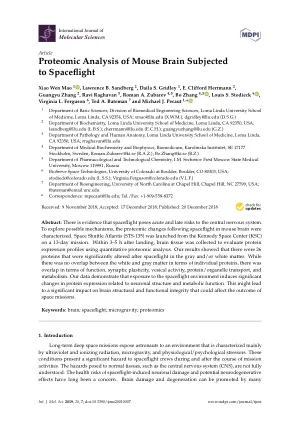
This research study aimed to understand why astronauts often experience changes in their vision after spending time on space missions, like those aboard the International Space Station (ISS). To do this, scientists looked at mice that were sent into space and then brought back down. They wanted to see if there are any differences between how these mice's eyes work compared to when they started before going up in a rocket for 35 days straight on the ISS. The study found some interesting clues about what might be happening inside astronauts' and space travelers' eyes that could lead to vision problems, like blurry or doubled images upon returning home from their time spent above Earth. The research suggests these issues may involve changes in eye structure and function due to the unique conditions of being in space for an extended period. The scientists focused on examining specific proteins within the eyes' tissues that could be linked with vision problems, as well as looking at signs of cell death related to oxidative stress-a kind of damage caused by harmful molecules called free radicals which can affect cells when they are exposed to unusual environments like space.
In this research paper, scientists investigated potential mechanisms behind vision impairments experienced by astronauts during space missions aboard the International Space Station (ISS). Using a mouse model with C57BL/6 genetic background, twelve male mice were launched into space on a SpaceX rocket for a 35-day mission. The study aimed to examine changes in protein expression profiles and oxidative stress-associated apoptosis within ocular tissues after exposure to microgravity conditions aboard the ISS. The methodology involved launching mice into space, where they were exposed to environmental factors associated with both actual spaceflight and simulated microgravity on Earth (parabolic flights). Upon their return to Earth, ocular tissues from these mice underwent analysis for changes in protein expression profiles related to vision impairments. Additionally, the study examined oxidative stress-associated apoptosis within retinal cells as a potential contributing factor to observed visual acuity alterations.
MLA
XW, Mao, et al. “Impact of Spaceflight and Artificial Gravity on the Mouse Retina: Biochemical and Proteomic Analysis..” PubMed Central, National Center for Biotechnology Information, https://www.ncbi.nlm.nih.gov/pmc/articles/PMC6165321/. Accessed 30 Sept 2026.
Chicago
XW, Mao, et al. “Impact of Spaceflight and Artificial Gravity on the Mouse Retina: Biochemical and Proteomic Analysis..” PubMed Central. 30 September 2026. https://www.ncbi.nlm.nih.gov/pmc/articles/PMC6165321/.