Analysis of interactions of Salmonella type three secretion mutants with 3-D intestinal epithelial cells.
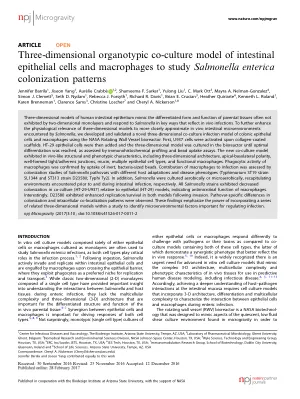
Researchers have been studying a type of bacteria called Salmonella, which can cause serious stomach illnesses when we eat contaminated food. One key part of how this bad bug makes us sick is by invading our intestinal cells - kinda like it's sneaking into the cell to make itself at home and multiply. This invasion process seems to need a special tool called the Type Three Secretion System, or T3SS for short. It works much like tiny molecular scissors that cut through barriers inside our bodies so Salmonella can get in where it shouldn't be. In this study, scientists looked at how well different types of Salmonella could enter human intestinal cells and found out some interesting things about the bacteria’s invasion tactics. They used lab-grown versions of our gut lining to see which ones were more successful invaders - it turns out that only certain strains with their T3SS tool can do this effectively, while others without these tools couldn't even get close.
This research paper delves into understanding how nontyphoidal Salmonella serovars, a significant cause of bacterial enteric disease and foodborne illness in the United States, interact with host intestinal epithelial cells. The study underscdems that for successful invasion by these pathogens, an essential feature is their interaction with host cellular mechanisms facilitated through Type Three Secretion System (T3SS), a bacterial 'molecular syringe' injecting effector proteins into the host cytosol to alter its functions. The researchers used mammalian cell lines, specifically HT-29 human colonic epithelial cells obtained from ATCC and grown in triple-sugar minimal essential medium supplemented with 10% fetal bovine serum for their experiments. They also employed wildtype Salmonella strains alongside SPI mutants to study the invasion process into these cell lines, including M-cells/M-like cells and enterocytes known for absorptive properties.
MLA
AL, Radtke, et al. “Analysis of interactions of Salmonella type three secretion mutants with 3-D intestinal epithelial cells..” PubMed Central, National Center for Biotechnology Information, https://www.ncbi.nlm.nih.gov/pmc/articles/PMC3012082/. Accessed 01 Oct 2026.
Chicago
AL, Radtke, et al. “Analysis of interactions of Salmonella type three secretion mutants with 3-D intestinal epithelial cells..” PubMed Central. 01 October 2026. https://www.ncbi.nlm.nih.gov/pmc/articles/PMC3012082/.