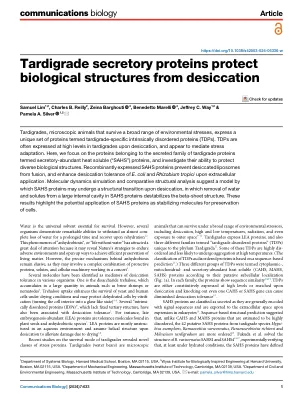
Desiccation of Hypsibius exemplaris
- February 17, 2025
In a recent study published in Genome Biology and Evolution, scientists James Fleming, Davide Pisani, Kazuharu Arakawa, along with their colleagues have made an exciting discovery about tardigrades-tiny creatures known as water bears that can survive extreme conditions like intense cold or dryness. These researchers looked closely at the genes of these remarkable animals and found out how they've developed special proteins to help them handle such tough environments, which is pretty amazing considering their size! The study corrected a mistake in an earlier version where colors used for representing different protein families were mixed up. Now we know that certain heat-shock proteins (CAHS) are shown in red and not blue as previously stated; MAHS should be purple, SAHS green instead of the other way around; EtAHS alpha is yellow while EtAHS beta appears pink rather than orange or black - these details help us understand tardigrades better.
The original research article, "The Evolution of Temperature and Desiccation-Related Protein Families in Tardigrada Reveals a Complex Acquisition of Extremotolerance," published by James F. Fleming et al., investigates the evolutionary history of protein families that confer tolerance to extreme temperatures and desiccation within tardigrades, also known as water bears or moss-pudenda. The study aimed at understanding how these organisms have adapted their proteomes over time in response to environmental stressors such as heat shock (HS) and dehydration/rehydration cycles. Methodology: The researchers employed a comparative genomics approach, analyzing the genome sequences of various tardigrade species alongside those from other eukaryotes with known extremotolerance mechanisms like Ascidia physalis and Tetrahymena thermophila.
MLA
“Desiccation of Hypsibius exemplaris.” PubMed Central, National Center for Biotechnology Information, https://www.ncbi.nlm.nih.gov/pmc/articles/PMC11831363/. Accessed 30 Sept 2026.
Chicago
“Desiccation of Hypsibius exemplaris.” PubMed Central. 30 September 2026. https://www.ncbi.nlm.nih.gov/pmc/articles/PMC11831363/.