Comparative genomic analysis of Cohnella hashimotonis sp. nov. isolated from the International Space Station.
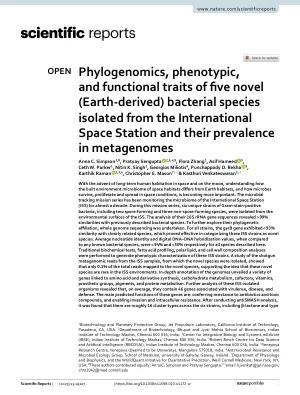
This research study looks at the tiny organisms, known as microbes or bacteria, that live in space on the International Space Station (ISS). The ISS is a special place where astronauts have lived for many years without being exposed to Earth's atmosphere. Because of this unique environment, scientists want to understand how these small life forms change over time when they are living with humans and not just floating in space. The study focused on two types of bacteria called Cohnella sp. F6_2S_P_1TandC. ginsengisoli . These microbes can help us understand how to keep astronauts healthy during long trips into space, as they are part of the natural 'microbiome' that lives with humans on Earth too. The researchers found out which bacteria were present and studied their genetic makeup using advanced computer programs called bioinformatics tools. This helped them to see how these microbes might behave differently in space compared to those living here on Earth, where they are exposed to different conditions like gravity and air quality.
The research paper titled "Microbial Evolution in the International Space Station (ISS) Habitat" by Simpson et al., published on Frontiersin Microbiology, investigates how microorganisms adapt to life aboard a closed-environment space habitat. The study's methodological approach involved sampling and analyzing bacteria from various sources within ISS-primarily human commensals but also new equipment/supplies and experiments conducted on board (Robinson et al., 2006; Checinska Sielaff et al., 2019). The researchers employed Non-metric Multidimensional Scaling (NMDS) ordination to visualize the microbial community structure and its evolution over time. The NMDS analysis used standardized Bray-Curtis distances with a maximum of five iterations, k=3 clusters for robustness in clustering species based on their genetic makeup using CAZymes (Carbohydrate Active Enzymes). Key findings revealed that the ISS microbiome is predominantly composed of human-associated bacteria.
MLA
AC, Simpson, et al. “Comparative genomic analysis of Cohnella hashimotonis sp. nov. isolated from the International Space Station..” PubMed Central, National Center for Biotechnology Information, https://www.ncbi.nlm.nih.gov/pmc/articles/PMC10308117/. Accessed 01 Oct 2026.
Chicago
AC, Simpson, et al. “Comparative genomic analysis of Cohnella hashimotonis sp. nov. isolated from the International Space Station..” PubMed Central. 01 October 2026. https://www.ncbi.nlm.nih.gov/pmc/articles/PMC10308117/.